Discover why stack emission testing and proactive air quality monitoring are vital for industrial plants in Nigeria to meet strict NESREA and LASEPA limits, avoid statutory penalties, and strengthen corporate ESG profiles
Introduction
As Nigeria’s industrial sector expands across key economic hubs like Lagos, Ogun, Port Harcourt, and Abuja, environmental accountability has taken center stage. Industrial operations—ranging from manufacturing plants and telecommunications tower generators to oil and gas facilities—release exhaust gases and particulates into the atmosphere.
To curb environmental degradation and safeguard public health, regulatory bodies like the National Environmental Standards and Regulations Enforcement Agency (NESREA) and the Lagos State Environmental Protection Agency (LASEPA) enforce stringent air quality standards. For facility managers and corporate executives, understanding and complying with these mandates is no longer optional; it is a core license to operate.
The Regulatory Landscape: What the Law Requires
Under Nigerian environmental law, industrial facilities must operate within legally defined emission thresholds. The primary regulations focus on controlling:
- Particulate Matter ($PM_{2.5}$ and $PM_{10}$): Fine dust and soot particles that impact respiratory health.
- Gaseous Pollutants: Sulfur Dioxide ($SO_2$), Nitrogen Oxides ($NO_x$), Carbon Monoxide ($CO$), and Volatile Organic Compounds (VOCs).
- Ambient Air Quality: The general air quality surrounding industrial perimeters and residential boundaries.
Exceeding permitted thresholds can result in heavy statutory fines, plant shutdowns, and reputational damage. Regular monitoring is the only way to ensure continuous compliance.
What is Stack Emission Testing?
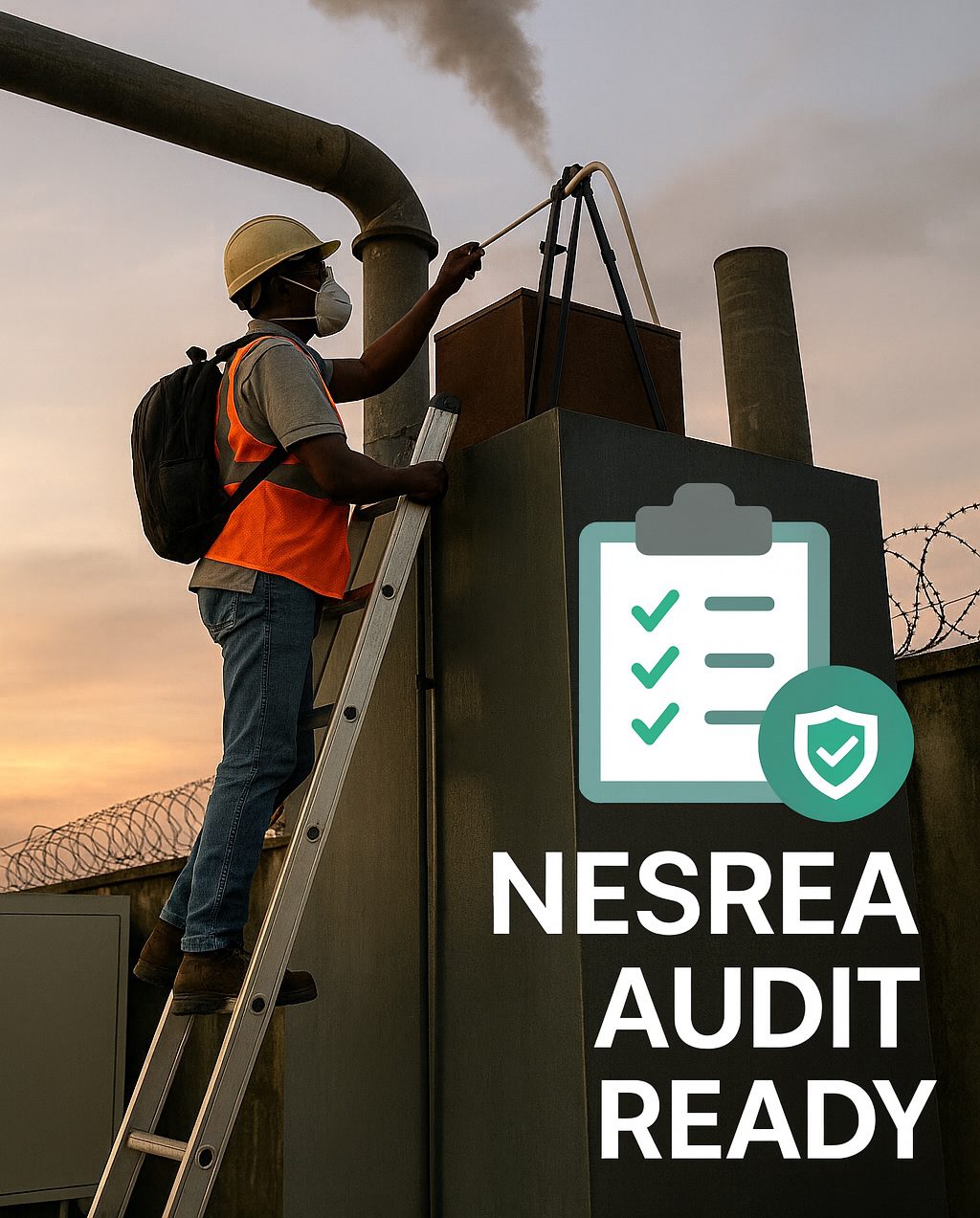
Stack emission testing (also known as source testing or stationary source sampling) is the rigorous scientific process of measuring pollutants discharged from an industrial stack, chimney, or exhaust pipe into the atmosphere.
Unlike ambient air monitoring (which measures the air people breathe around a facility), stack testing evaluates the direct output of industrial processes. A professional testing protocol involves:
- Isokinetic Sampling: Collecting representative gas samples at velocities matching the gas stream inside the stack.
- Laboratory Analysis: Profiling chemical concentrations and particulate loads against statutory limits.
- Engineering Recommendations: Providing actionable data to optimize combustion efficiency and pollution control equipment (such as scrubbers or baghouses).
How Ecobinder Services Limited Can Help
At Ecobinder Services Limited (ESL), we deploy advanced sampling equipment and certified air quality specialists to help industrial operators across Nigeria stay fully compliant. Our comprehensive air quality solutions include:
- Continuous and periodic stack emission testing for NESREA and state EPA compliance.
- Ambient air quality mapping and baseline data collection.
- Preparation of statutory air quality permit applications and renewals.
Ready to ensure your facility meets national air quality standards? Contact Ecobinder Services Limited today to schedule a professional compliance audit.